

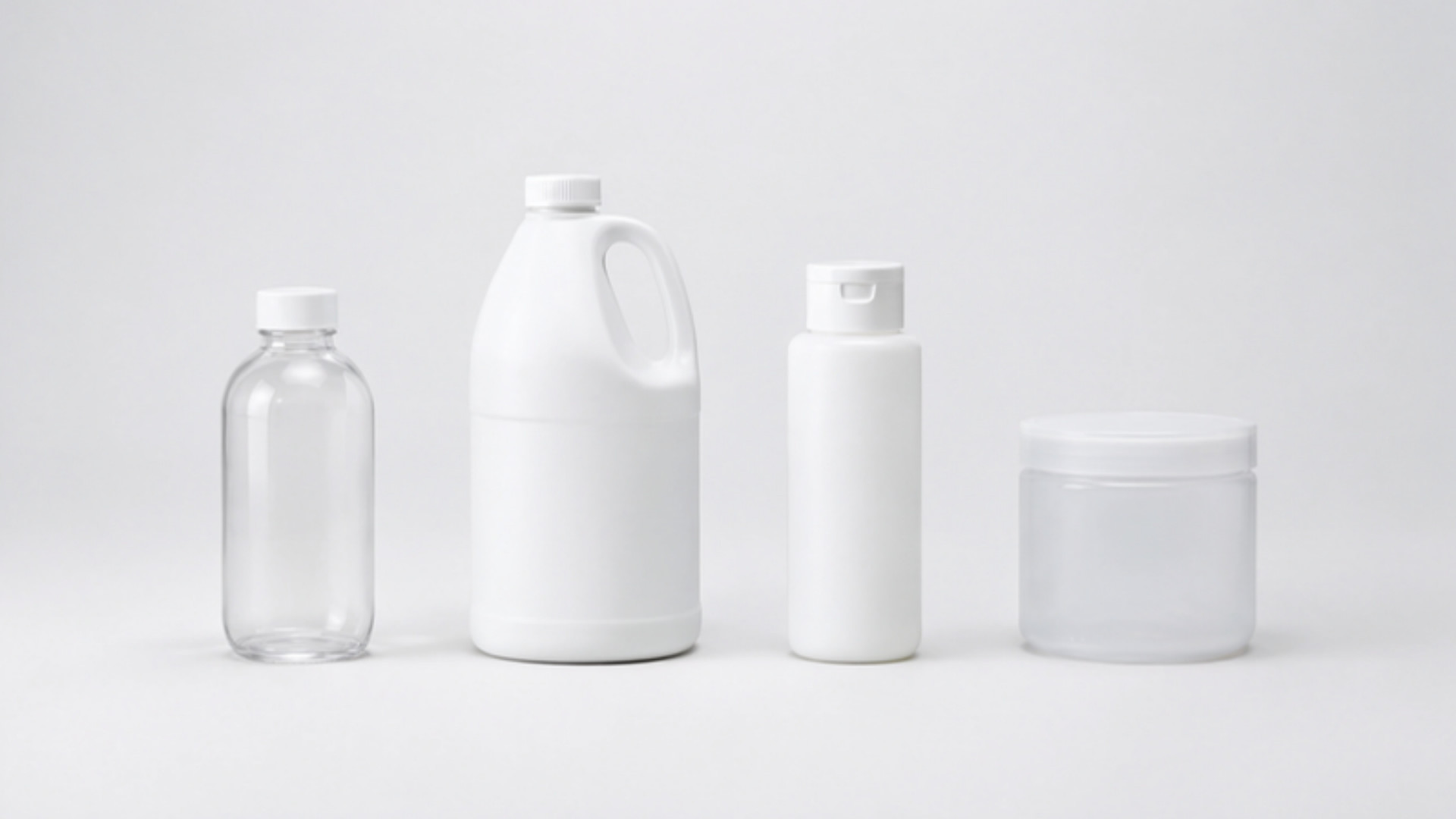
Plastic Bottles: Types, Resins, and How to Source Them for Your Brand


Last updated: November 16, 2026
In short: Four common bottle resins are PET, HDPE, LDPE, and PP. PET can be very clear and glossy, a good fit for a 500 ml shampoo or cold-pressed juice bottle. HDPE is tough and commonly translucent or opaque, a good fit for a 1 gallon laundry or cleaner jug. LDPE is flexible, so it is used for squeeze bottles. PP is often considered when the pack needs more heat resistance than standard PET, depending on the grade and the bottle spec.
If you also sell in glass, see our guide to glass bottle manufacturers. This page is about plastic.
What are the main types of plastic bottles?
PET is polyethylene terephthalate. HDPE is high-density polyethylene, and LDPE is low-density polyethylene. PP is polypropylene. PETG is a glycol-modified PET. Don't guess its resin code from the name. Check the mark on the container and the supplier's documents for the exact resin grade. Not every PP bottle is suitable for the microwave either. Confirm that the finished container and closure are specified for that use, with food-contact documents to back it up. The resin grade alone is not enough.
| Resin | Resin code | Look and feel | Typical products |
|---|---|---|---|
| PET | 1 | Clear, glossy, rigid | 500 ml Boston round for shampoo or juice |
| HDPE | 2 | Natural milky or opaque, tough | 1 gallon laundry or cleaner jug |
| LDPE | 4 | Soft and flexible | Squeeze bottle with a flip-top cap for sauce, lotion, or glue |
| PP | 5 | Semi-translucent, stiffer than LDPE | Some hot-fill food packs and many closures |
| PETG | Check the mark | Clear, and suitable grades can do thick walls | Cosmetic bottles, jars, and some airless packs |
The number inside the recycling triangle is the resin identification code. It names the plastic. A resin code is not a recycling promise, and it does not guarantee that your local program will collect or recycle that bottle. PET and HDPE bottles and jugs are common recycling-program materials, but check the local rules for each item, including LDPE and PP containers.
PET vs HDPE: which should you choose?
Choose PET for a clear, glossy pack. Choose HDPE for a tougher, more opaque pack. A family name alone doesn't make either resin suitable for food or cosmetics. Ask for the compliance documents for the specific resin grade and the finished bottle. Don't describe a bottle as "FDA approved." Our product certification and compliance guide explains the paperwork to request.
What is a soft (squeeze) plastic bottle made of?
LDPE is commonly used for soft squeeze bottles. Its branched polymer chains pack less closely than HDPE's, so it is less dense and generally more flexible. Check the finished bottle's squeeze and recovery on a sample, not only the resin name. Ask for samples in more than one wall thickness. A very thin bottle can collapse, and a very thick one can be hard to squeeze.
Which bottle suits your product?
- Beverages: a clear PET Boston round or cylinder
- Personal care: a clear PET Boston round for shampoo, often with a disc-top or a pump. See our beauty products page.
- Supplements: a wide-mouth HDPE or PET packer bottle for capsules or tablets
- Household chemicals: a natural or opaque HDPE jug, often with a trigger sprayer or a child-resistant cap
- Cosmetics: PETG bottles and jars, or an airless pump bottle, for a clear, thick-wall pack
Always test your actual formula in the proposed bottle and closure, under the conditions it will be used and stored in. Some oils, solvents, and other ingredients can cause stress cracking, swelling, or other damage in certain plastics.
Bottle shapes, necks, and closures to specify
Name the shape, not just "a bottle." Common stock shapes are Boston round, cylinder, oval, and packer.
Then lock the neck finish and the closure together. A neck finish such as 24/410 or 28/410 is a standard way to describe the neck. The first number is the nominal outside diameter across the threads, in millimeters, and 410 identifies the finish series. A standard 24/410 flip-top, disc-top, lotion pump, or trigger sprayer will not fit a standard 28/410 neck. Child-resistant caps have to match the same finish. Order the bottle and cap as a matched set, or confirm both against the same neck standard.
Is your bottle factory who it says it is?
Get a supplier verification report before you pay a deposit.
Get your supplier verifiedHow do you source custom plastic bottles?
A stock mold is a bottle shape the factory already makes. A custom mold is a new tool made for your own shape. You can often start with a stock bottle plus your own labels or a stock color. A new custom mold usually means a larger order. We're a service, not your supplier, so we don't set minimums. Factories set their own, and we negotiate a starting quantity that suits your budget. See what MOQ means and how to negotiate it. Beauty brands often launch on an off-the-shelf bottle that's an 80 to 90% match, then pay for a custom mold once the product sells.
Decoration options include silk screen, hot stamping, paper or film labels, and shrink sleeves. Send a Pantone or physical color standard, and approve a colored sample, not only a digital proof. Color can fail to match from one run to the next, so approve a color standard and check every batch.
Put the bottle on a product specification sheet. List the resin, color, capacity, shape, neck finish, closure, wall thickness or bottle weight, decoration, and tests. Also see how much product samples cost, how to source custom packaging from China, and our packaging industry page.
If you are designing the bottle and the product from scratch, look at our private label service. It is the CUSTOMISER Private label package. If you want your logo on a bottle a factory already makes, look at white label (the Importer White label package). Current fees are on our pricing page.
What should you check before you order?
Before you approve a bulk run, check wall thickness and weight against the approved sample. Run leak and drop tests with the chosen closure, and test for stress cracking, swelling, or odor transfer. Ask for food-contact or cosmetic paperwork for your market. Then arrange a pre-shipment check against your AQL plan. Our team can help you turn that list into a clear spec, compare samples from shortlisted factories, and arrange checks before goods ship.
FAQs
Is PET or HDPE better for food and drinks?
PET is the usual choice for a clear bottle, and HDPE for a tougher, more opaque pack. Food-contact use depends on the resin grade and the finished bottle. Don't say "FDA approved."
What do the numbers inside the recycling triangle mean?
They are resin identification codes: 1 is PET, 2 is HDPE, 4 is LDPE, and 5 is PP. The code names the plastic. It is not a recycling promise, so check what your local program accepts.
Can I order custom plastic bottles in small quantities?
You can often start with a stock bottle plus your own labels or a stock color. A new custom mold usually means a larger order. We're a service, not your supplier, so we don't set minimums. Factories set their own, and we negotiate a starting quantity that suits your budget. You can start a conversation through our pricing page.
What is the difference between PET and PETG?
PETG is PET modified with glycol. Suitable PETG grades are used for clear cosmetic bottles and jars, including thick-wall designs. Whether it is easier to process than bottle-grade PET depends on the grades, the molding process, and the design.
How do I know a bottle factory is real?
Don't rely on a website or a catalog photo. Get the factory checked before you pay a deposit, starting with our supplier verification page.
Want help sourcing custom plastic bottles?
Talk through your bottle spec, decoration, and factory shortlist with Epic Sourcing.
Book a free discovery chatRelated Articles


Let’s Make It Epic
We're here to make sourcing simple, and a whole lot less stressful.
We are experiencing a higher volume of enquiries than usual. Our standard reply time for form submissions and emails is within 72 hours.
If your matter is urgent, please schedule a video call using the link below.
